Lifecycle assessment accounts for the carbon a building embodies in its materials, not only the energy it uses in operation. Modules A1 through C4, calculated to EN 15978, prepared for the certification credit and for the client's own carbon accounting.
EN 15978
standard
A1 to C4
lifecycle modules
50y
reference study period
What is whole-building LCA?
A lifecycle assessment quantifies a building's environmental impact across its life: raw material extraction, manufacture and construction (the A modules), the use stage (B), and end of life (C). The headline output is embodied carbon, the emissions committed to the building before the first occupant arrives.
Embodied carbon is where regulation and certification are heading. LEED, BREEAM and DGNB all reward it, EU-level reporting increasingly requires it, and as operational energy falls, the embodied share of a building's footprint grows.
The assessment covers the whole building rather than a single assembly or product, and that scope is what makes it useful for decisions. Adding insulation, for instance, increases the material impact of the envelope, but it usually reduces operating energy by enough to produce a net benefit across the building's life. Only a whole-building assessment can show that trade-off, because the cost sits in one part of the model and the saving in another.
Our assessments follow EN 15978 and use the project's own bill of materials with EPD data. Because the LCA is produced alongside the structural and MEP design, its findings arrive while the material choices are still open.
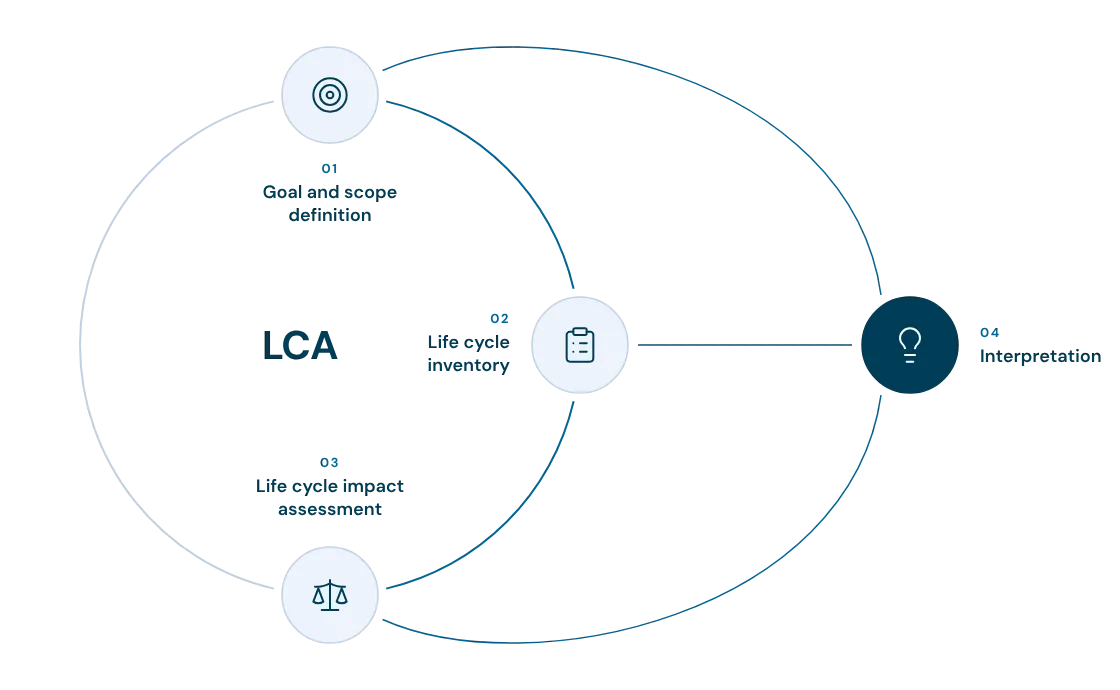
the process
How whole-building LCA works
step 01
Scope
Study period, modules and building elements set to the applicable standard and the certification target.
step 02
Inventory
Material quantities from the design model, matched with EPD and database records.
step 03
Assessment
Impacts calculated across the modules, with the largest contributors identified while substitution is still possible.
step 04
Reporting
Results in the format the certification credit, the client's disclosure, or both require.
from our portfolio
LCA projects we've delivered
LCA increasingly accompanies our BREEAM and DGNB work.
The value of a lifecycle assessment depends almost entirely on when it arrives. Run alongside the design, it can still shape the concrete, steel and façade decisions that carry most of the embodied carbon.
Run afterwards, it becomes a record rather than a tool, which is worth knowing when the assessment is being scheduled.
01 standards
Calculated to EN 15978
Scope, module coverage and data quality follow the standard, so the result stands up in a certification review and in a disclosure audit. An assessment that departs from the standard is difficult to compare with anything and difficult to defend.
02 timing
Design-stage timing
The assessment runs alongside the design, identifying the elements that dominate the embodied carbon, usually the frame, the slabs and the façade, while those specifications can still change. It also lets alternatives be compared at each planning stage, so a material substitution is evaluated on its whole-life effect rather than its embodied figure alone.
03 data
Working knowledge of EPDs
We prepare environmental product declarations as well as use them, which gives us a practical sense of how supplier data is produced, where its assumptions sit, and how much weight it can carry in a whole-building calculation.
04 reporting
Certification-ready output
LEED, BREEAM and DGNB each have their own format for lifecycle results. We produce the output in the form the credit asks for, so it goes into the submission without a second calculation.
Related services
EPD
EPD
Environmental product declarations to EN 15804, from the product lifecycle assessment through third-party verification to publication.
A European lifecycle-quality framework, strongest in Germany, Austria, Switzerland and Denmark. Ecology, economy and occupant quality are scored together, with lifecycle assessment and costing carrying much of the weight.
A short call is usually enough to scope the assessment and, more usefully, to time it so the findings arrive while the material decisions are still open.