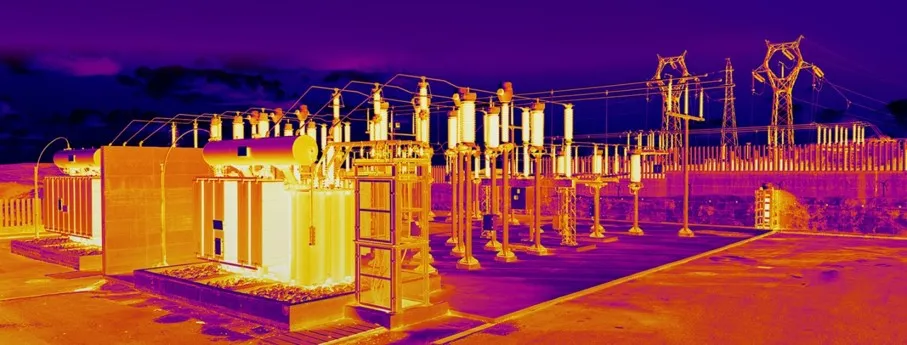
An infrared survey shows what the envelope conceals: thermal bridges, missing insulation, moisture paths, and equipment running hotter than it should. Thermography makes these visible, and a visible defect is one that can be put right.
EN 13187
envelope standard
2011
surveying with thermography since
IR
infrared, envelope, and plant
What is Thermography?
Thermographic inspection maps surface temperatures with an infrared camera, revealing what a visual inspection cannot: heat escaping through thermal bridges, insulation gaps behind finished surfaces, air leakage paths, moisture accumulation, and electrical or mechanical components running hot.
For new buildings, the survey checks that the built envelope matches the designed one, to EN 13187. For existing buildings, it is an efficient way to survey the fabric: an afternoon of imaging can map defects that have accumulated over decades. Paired with a blower door test, it shows not only that a building leaks, but where. We have used the method since 2011, including in protected buildings, where it locates moisture and thermal anomalies behind frescoes and historic surfaces without touching them.
We survey with Testo 882 infrared cameras, then interpret and recommend. Beyond the envelope, the same survey can find overheating electrical connections and mechanical components running hot through friction. The image shows a temperature difference; the useful part is understanding what causes it and what to do about it.
the process
How a thermography survey works
step 01
Conditions
The survey planned around the temperature difference and weather the method requires.
step 02
Surveys
Systematic imaging of the envelope and, where in scope, plant and electrical systems.
step 03
Interpretation
Anomalies classified as thermal bridge, void, leakage, moisture or artefact, with severity assessed.
step 04
Report
Findings with locations, causes and remedial priorities, documented for use as evidence.
from our portfolio
Thermography projects we've worked on
Thermography surveys across Serbia, Italy, Switzerland and beyond, from public infrastructure to commercial high-rise.
An infrared survey answers a question most building owners have but few can settle: whether the envelope performs the way it was meant to.
Taking the image is the straightforward part. What makes it useful is knowing which patterns are real defects, which are reflections, and what each one would cost to put right. Each defect it finds is heat being lost and comfort being lost in the same place.
01 Expertise
Interpretation experience
Reflections, surface emissivity and moisture can each look like a defect, and a real defect can hide behind them. Interpreting a thermogram takes experience with buildings, not only with cameras.
02 method
Pairing with air-tightness
Run alongside a blower door test, thermography shows where the air is leaking. Run alongside commissioning, it shows whether systems are performing under load. Each method sharpens the other.
03 application
Surveys for existing buildings
For retrofit planning and acquisition due diligence, an infrared survey establishes the envelope's condition before the budget is set. It is one of the fastest ways to find out what a building will need.
04 reporting
Evidence-grade reporting
Reports follow the standard and are prepared for use as evidence: in a certification submission, a warranty claim, or an acquisition file.
Related services
BDT
Blower Door Testing
Envelope air-tightness measured to EN ISO 9972, with smoke and infrared tracing to locate the leaks when the result falls short of target.
Mechanical, electrical and plumbing design from concept to construction issue, engineered against a modelled performance target and verified after handover.
Alignment assessed against the EU's technical screening criteria. Energy thresholds, climate adaptation and do-no-significant-harm conditions, verified rather than declared.
Building-systems verification and testing across handover, occupancy and the first operating year. Fundamental and enhanced Cx, with the correspondence held in-house.