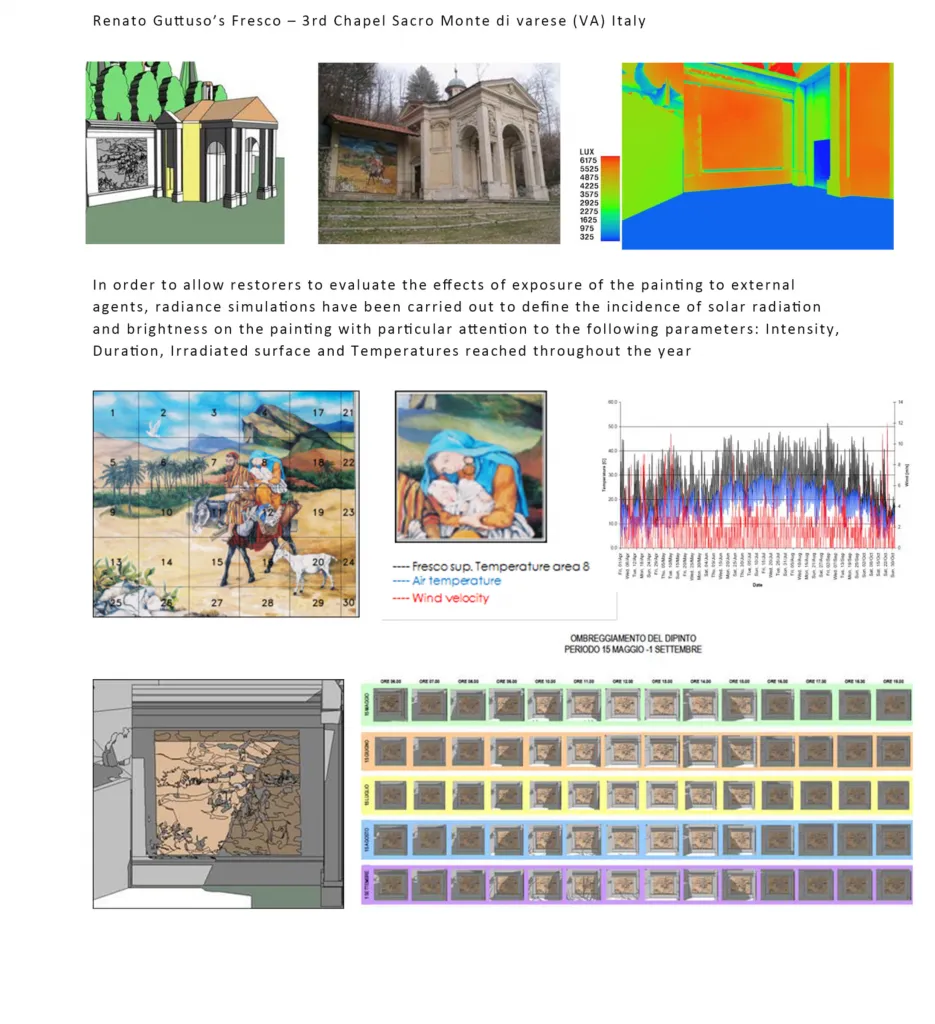
Monuments, frescoes and paintings are exposed to radiation, temperature and moisture that change through the day and the year. We simulate that atmospheric forcing, indoors and outdoors, and resolve its effect at the surface of the artwork, so conservation decisions rest on what the material is actually experiencing.
In + out
interior and exterior exposure modelled
Day + year
radiation and moisture cycles simulated
3
purposes: exploratory, preventive, interpretive
What is Radiance Simulation?
Cultural heritage deteriorates through physics: solar and thermal radiation on a wall, temperature cycles that expand and contract a pigment layer, moisture that moves through plaster and stone. Radiance simulation quantifies these forces. Using computational fluid dynamics and radiation modelling, it produces boundary conditions at the surface of a fresco, a painting or a monument that are resolved in both space and time, so the hygrothermal and mechanical loads on the material can be examined rather than guessed.
The simulations serve different purposes. Some are exploratory, establishing how a space behaves before any intervention is considered. Most support preventive conservation, showing where radiation and moisture concentrate and what protection or conditioning would change. Occasionally they help with interpretation, explaining why deterioration follows the pattern it does.
The work extends outdoors as well as in: the slow air movement of an interior with its temperature and humidity, and the exposure of a façade or a monument to sun and weather. The Napoleonic Halls of the Pinacoteca di Brera and the Guttuso fresco at the Sacro Monte di Varese were both studied this way.
the process
How radiance simulation works
step 01
Survey and model
The geometry, orientation, materials and existing conditions captured, with the conservation questions defined alongside the heritage team.
step 02
Simulation
Solar and thermal radiation, temperature and moisture simulated through the daily and annual cycle, indoors or outdoors as the case requires.
step 03
Surface conditions
Boundary conditions resolved at the artwork or monument surface, in space and over time.
step 04
Findings presentation
Where the loads concentrate, what they mean for the material, and what protection or conditioning would change them, documented for the conservation decision.
from our portfolio
Radiance projects we've delivered
Galleries, chapels and monuments studied for the radiation and climate their artworks receive.
A conservation decision is easier to make, and easier to defend, when the loads on the artwork are known rather than assumed.
Simulation gives the conservation team that knowledge before anything is installed or moved, and it does so without touching the surface.
01 precision
Resolved at the surface
The boundary conditions are produced at the artwork itself, not as a room average. That is the figure a conservator needs and the one a conventional calculation does not provide.
02 scope
Indoors and outdoors
Interior microclimates and external exposure are modelled with the same method, so a monument's façade and its interior can be understood together.
03 integration
Alongside heritage CFD
Radiance simulation sits alongside our airflow and microclimate work in protected buildings, so where an intervention follows, the conditioning design can draw on both.
04 approvals
Findings in conservation terms
Results are written in the terms conservation bodies use, so the committee that decides can read the engineering directly.
Related services
CFD-hb
CFD for Heritage Buildings
Conditioning modelled inside protected fabric, with the microclimate resolved at the artefact and the intervention kept reversible.