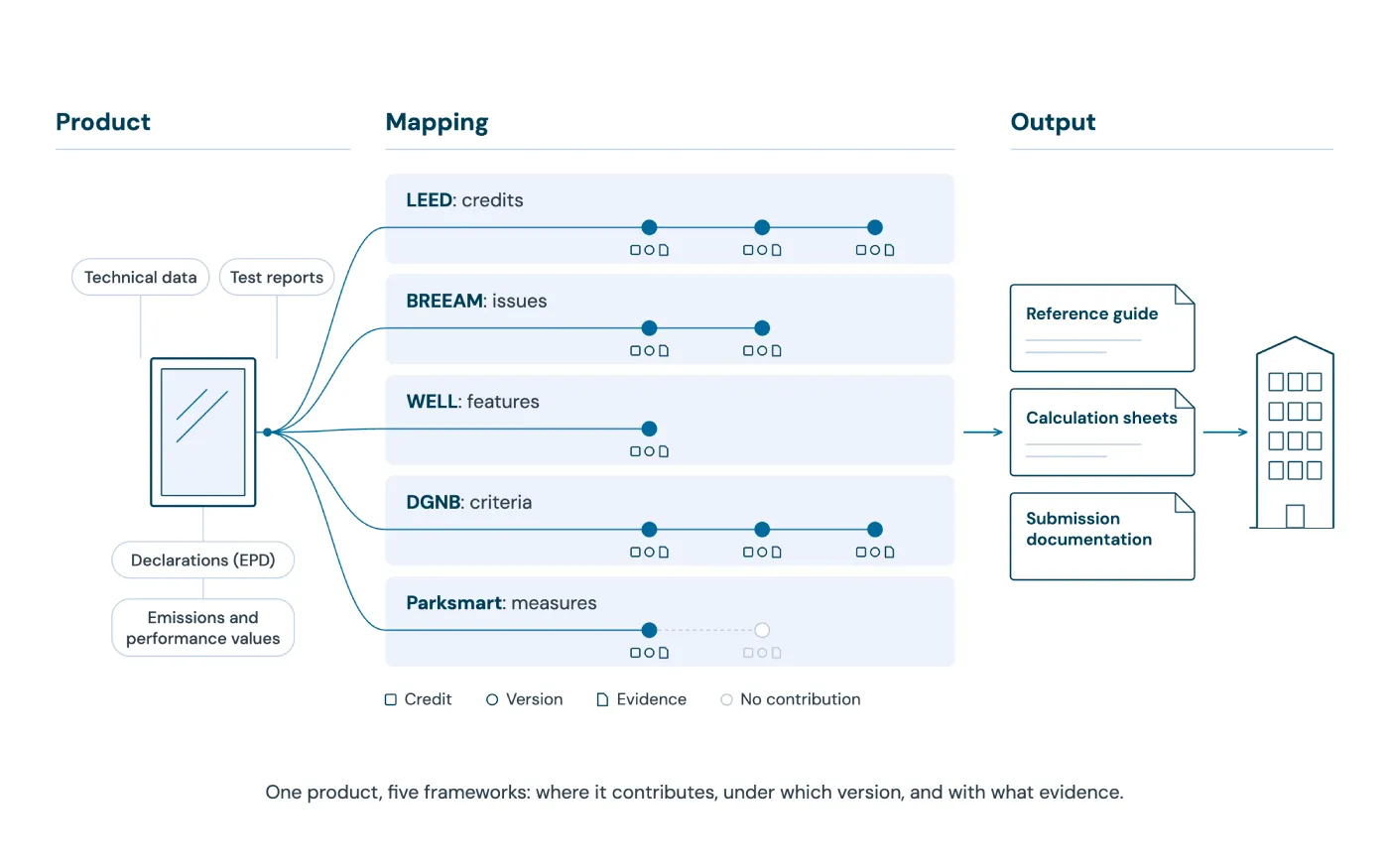
A product is specified in a certified building when the project team can see, credit by credit, what it contributes. The Green Target Program maps a manufacturer's products and components against LEED, BREEAM, DGNB, WELL and Parksmart, and produces the documentation a specifier will ask for.
5
frameworks mapped
3
outputs: guide, calculations, documentation
Credit
by credit mapping for each product
What is the Green Target Program?
Certification frameworks reward buildings, not products, but a building earns its credits through the products it is built from. A low-emitting paint, a water-efficient fixture, a glazing unit with the right performance, an insulation product with a declaration: each contributes to specific LEED credits, BREEAM issues, WELL features, DGNB criteria or Parksmart measures. Knowing a product is relevant is the starting point. What a project team needs is to which credit, under which version, and with what evidence.
The Green Target Program answers that. It assesses a product or component against the requirements of each framework and maps where it contributes and what documentation is needed to claim it. The output is a reference guide for the product, the calculation sheets that support its contribution, and the documentation a project team can drop into a submission.
The mapping draws on our own certification work, so it reflects what a project team will ask for and what a reviewer will accept. A credit that looks achievable on paper and a credit a reviewer accepts are not always the same thing.
the process
How the Green Target Program works
step 01
Product review
Technical data, test reports and existing declarations gathered for the product or range.
step 02
Mapping
The product assessed against the credits, issues, features, criteria and measures of each framework, with the contribution and the evidence requirement identified for each.
step 03
Documentation
A reference guide, calculation sheets and specifier-facing documentation prepared for the product.
step 04
Application
The documentation put to use in the manufacturer's technical material and, where a project asks, in a specific submission.
from our portfolio
Projects from our portfolio
Selected projects across Serbia, Italy, Switzerland and beyond.
The useful question for a manufacturer is not whether a product is sustainable, but which credit it earns, under which framework, and what the project team will need to see.
That is a specific question with a specific answer, and the answer is worth more to a specifier than any general claim.
01 Expertise
Mapped by certifiers
The mapping draws on our work on LEED, BREEAM, DGNB, WELL and Parksmart projects. It reflects what reviewers accept, not only what the reference guide permits.
02 scope
Five frameworks, one document
A product is assessed against all five frameworks at once, so the manufacturer has one reference guide rather than five partial ones.
03 guidance
Documentation specifiers can use
The output is written for the project team: what the product contributes, where, and what evidence supports it, in the form a submission needs.
04 professionalism
Mapping, not endorsement
We do not certify or endorse products. The program establishes what a product contributes and documents it accurately; the specification decision stays with the project.
Related services
EPD
Environmental Product Declarations
Environmental product declarations to EN 15804, from the product lifecycle assessment through third-party verification to publication.
The most widely used green-building rating system, across new construction, interiors, existing buildings and homes. We hold GBCI Proven Provider status for BD+C.