
courses … get in touch for more information
Upcoming training courses
- Belgrade (Serbia) – 05.03
- Bellinzona (Switzerland) – 12.03,
- Zurich (switzerland) – 16 .03
European company recognized USGBC EDUCATION PARTNER
Training courses programmes
Why still LEED V4 courses?
As LEED v4 gradually sunsets and LEED v5 is introduced, the availability of LEED v4 professional exams is limited, while LEED v4 projects remain active during the transition.
As part of the LEED evolution, LEED v4 professional exams will be retired in 2026. The last opportunity to sit for the LEED v4 Green Associate exam is April 26, 2026, and the final chance to take the LEED v4 AP with Specialty exams (including BD+C) is June 28, 2026. After these dates, all candidates will transition to LEED v5 exams.
For LEED v4 projects, teams have until June 30, 2026 to register new commercial projects under LEED v4 or v4.1 (BD+C, ID+C, O+M). Projects registered by that date will retain a timeframe to complete certification up to June 30, 2032.
This course provides a timely opportunity for professionals interested in LEED v4 to strengthen their knowledge while CE hours are still available, and while some candidates may still choose to take LEED v4 exams before the deadlines.
Energo’s live LEED v4 BD+C course, submitted for GBCI CE hours, provides a structured overview of the rating system and practical application. While not an exam preparation course, the content may be used as a valid reference for professionals preparing for a LEED v4 exam and supports ongoing credential maintenance through CE hours.
LEED V5 courses
This course introduces the structure and technical foundations of LEED v5 for BD+C, while also providing a focused transition overview for LEED v4 professionals. It explains key structural changes including carbon-centered prerequisites, embodied carbon quantification, resilience integration, and updated performance verification requirements. Suitable for both first-time LEED users and experienced practitioners, the course builds foundational knowledge and clarifies how LEED v5 redefines compliance and certification strategy.

LEED Courses overview
This live, instructor-led course provides a comprehensive overview of the LEED Building Design and Construction (BD+C) rating system, focusing on its structure, evolution, and practical application across all major credit categories. The program is designed to support professionals involved in the design, construction, and delivery of LEED projects by clarifying how sustainability objectives are translated into measurable project requirements, documentation strategies, and certification outcomes.
The course examines the LEED certification framework, including the role of USGBC and GBCI, the certification process, Minimum Program Requirements (MPRs), certification levels, and the organizational logic of the rating system. Participants will explore all BD+C credit categories—Location and Transportation, Sustainable Sites, Water Efficiency, Energy and Atmosphere, Materials and Resources, Indoor Environmental Quality, Innovation, and Regional Priority—through a structured analysis of credit intent, compliance pathways, strategic coordination, and documentation requirements.
Particular attention is given to the evolution of the rating system and its transition from an efficiency-based model toward a more impact-driven and performance-centered framework. The course highlights how LEED increasingly integrates carbon accountability, climate resilience, lifecycle thinking, measurable outcomes, and equity considerations within the certification structure.
Key Learning Areas
Participants will examine:
-
The development logic and structural evolution of the LEED BD+C rating system
-
The organization and weighting of credit categories
-
The relationship between prerequisites, credits, and measurable environmental outcomes
-
The integration of carbon assessment, embodied carbon evaluation, and operational performance verification
-
Climate resilience considerations within project design
-
The role of lifecycle thinking in material and energy decision-making
-
Expanded emphasis on documentation rigor and accountability
-
Interdisciplinary coordination requirements across design and construction phases
-
The certification workflow from early concept through final review
The course emphasizes strategic understanding rather than isolated technical calculations. It clarifies how LEED requirements influence project planning, design integration, material selection, energy strategy, indoor environmental quality, commissioning, renewable energy integration, refrigerant management, lighting quality, and long-term operational performance.
Practical Application
Real project examples and case references are used to illustrate how LEED requirements are implemented in practice. Participants will explore common compliance paths, credit synergies, and coordination challenges that arise in multidisciplinary project teams.
Interactive discussions and structured knowledge-check exercises reinforce applied understanding and support participants in translating rating system requirements into actionable project strategies.
Target Audience
This course is intended for:
-
Architects
-
Engineers
-
Sustainability consultants
-
Project managers
-
Developers
-
Contractors
-
Facility managers
-
Built environment professionals involved in LEED BD+C projects
It is suitable both for professionals new to LEED and for experienced practitioners seeking a structured understanding of the system’s evolution and its strategic implications.
Benefits of the Course
Participants will:
-
Gain a clear and structured understanding of the LEED BD+C rating system
-
Understand how sustainability objectives connect to project decisions and documentation
-
Improve their ability to interpret prerequisites and credits
-
Develop awareness of carbon-focused and performance-based compliance expectations
-
Strengthen interdisciplinary coordination skills within LEED project teams
-
Build confidence in navigating the certification process from design through review
Pre-Requisite Knowledge
Participants are expected to have a basic familiarity with green building concepts or prior exposure to sustainability-related projects. No advanced technical calculations or prior LEED credential are required.
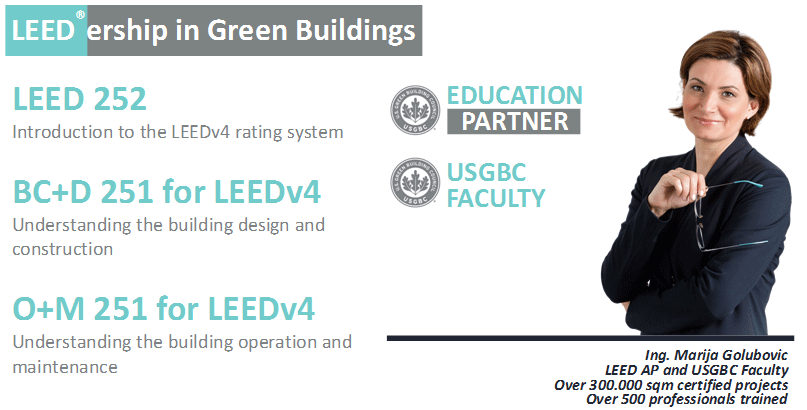
ENERGO is a USGBC® Education Partner™
USGBC Education Partners are vetted providers of green building and sustainability education, held to standards set by the U.S. Green Building Council. For our clients, this means every course Energo delivers meets internationally recognised quality benchmarks, and that all attendee hours are reported directly to GBCI through an automated system, with a streamlined CE approval process.
With nearly two decades of hands-on LEED certification experience, we offer training at both foundational and advanced levels. Our courses include a curated selection of LEED Case Studies developed directly from buildings certified by our own team.
Over 500 professionals have attended our courses since we began. Beyond open enrolment courses, available in person and via live webinar, we develop tailored in-house programs for companies and project teams. Past clients include Grundfos, Daikin, Bouygues, and E2K, each requiring a distinct approach based on project type, team profile, and corporate sustainability objectives.
Our lead instructor, Marija Golubović, holds two of the highest distinctions in the LEED community: USGBC Faculty and LEED Fellow. This positions Energo as a reference point for advanced LEED education in Europe.